

Differences Between Mind Maps and Concept Maps
Visual thinking and different mapping techniques offer powerful tools for organizing, analyzing, and presenting knowledge in a time when information is both plentiful and complex. Every tool, including mind maps and concept maps, has a distinct function when it comes to organizing data. The unique characteristics of each approach and the significance of visual thinking in improving cognitive function will be discussed below.
1. Mind Maps
Created by Tony Buzan in the 1970s, mind maps are characterized by a single central idea that radiates outward with subtopics branching off in a tree-like fashion. These branches can continue to break down into further subtopics, creating multiple layers of knowledge, just like in the example below.
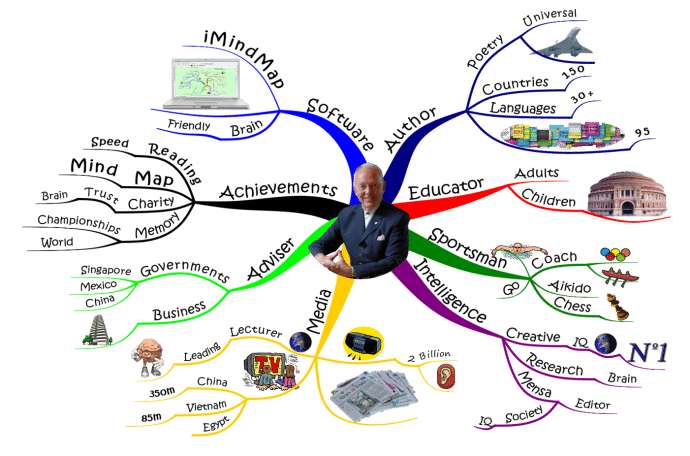
By combining visual and textual approaches, mind maps are a powerful learning technique, extremely useful when trying to memorize content, brainstorming with colleagues, or even organizing notes for quick reference. Some characteristics are:
- Radial structure -> Starts from a central node and expands outward.
- Images, colors, and symbols are combined with text.
- Free flow: The student has control and decides both the format and the content of the mind map.
How to create a mind map
Of course, you can always use pen and paper. But since most work and study happen digitally today, it’s often worth exploring online mind map tools.
Among the available options, NodeLand stands out as it allows each node of the mind map to store information (text, images, videos, documents) directly attached to it.
After choosing your tool, the next step is defining the central node. This may sound straightforward, but the central idea influences every layer that follows, so it’s worth choosing carefully.
Once the central node is defined and written, you can begin exploring the content and adding the main branches.
Use Cases:
Managing organizational knowledge and expertise.
Mapping research domains or academic subjects.
Supporting decision-making in complex problem-solving environments.
2. Concept Maps
Concept maps, often used in educational settings, are structured tools designed to represent relationships between ideas in a hierarchical fashion. Concept maps, as developed by Joseph D. Novak in the 1970s, help learners organize and integrate new information into their existing knowledge base by visualizing connections between concepts, often structured with lines and linking words indicating relationships.
Key Characteristics:
- Hierarchical structure:
- Concepts are arranged in a top-down hierarchy from the most general to the most specific.
- Linking phrases explaining the relation between concepts.
- Words or phrases on connecting lines specify the nature of the relationships between concepts.
- Focused on learning:
- Emphasizes the understanding of relationships between concepts for deeper learning.
Use Cases:
Teaching complex topics by breaking them into related sub-concepts.
Evaluating students' understanding of subject matter.
Creating a structured knowledge path for educational purposes.
Use Cases:
Explaining a business process through a flowchart.
Visualizing data trends using graphs or charts.
Mapping out organizational hierarchies or decision trees.
TL;DR
Mind maps and concept maps are powerful visual thinking tools often treated as synonyms. They are indeed similar, but they serve different purposes.
In a mind map, the author is in control: it is possible to create branches and explore subtopics of a central theme in whatever way is most convenient. There are also few formal rules, although mind maps usually have a radial structure.
Concept maps, on the other hand, have a more hierarchical structure, with a visual organization that somewhat resembles an organizational chart. Concept Maps usually have linking phrases explaining the relation between concepts.
The Importance of Visual Thinking
Visual thinking refers to the process of using images and spatial relationships to solve problems, organize information, and communicate ideas. The neurological basis for its effectiveness lies in how humans process information: about one-third of the brain is dedicated to vision, meaning visual information is processed much faster and more efficiently than text.
Key Benefits:
- Improved Memory Retention:
- Visual aids like maps and diagrams engage different cognitive pathways than text alone, enhancing the brain’s ability to recall information.
- Faster Information Processing:
- Visuals provide an immediate overview, making it easier to grasp large or complex datasets quickly.
- Enhanced Creativity and Problem-Solving:
- Visual thinking enables free-flowing connections between ideas, encouraging creativity and innovative solutions.
In Learning and Knowledge Management:
The use of visual tools like mind maps and concept maps plays a critical role in navigating today’s vast information landscape. These tools not only support better organization and learning but also foster deeper engagement with the material. For example, concept maps are particularly useful for structuring learning paths, allowing students to explore topics in a logical, connected way.
Whether for creative brainstorming, educational purposes, or managing complex systems, these tools optimize how we perceive, process, and retain information, underscoring the critical importance of visual thinking in today's information-driven world.
